

If you are one of the millions of people who start their morning with a fresh cup of coffee, you likely give little thought to what happens after your last sip.
Globally, we generate an estimated 10 billion kilograms of spent coffee grounds every year. Most of it goes straight to landfills, where decomposing organic waste releases methane, a greenhouse gas that traps heat in the atmosphere far more potently than carbon dioxide.
Another future scarcity: We are running out of natural sand
At the same time, the construction industry faces a quiet crisis of its own: We are running out of sand.
Natural sand mined from riverbeds and coasts is the second most consumed natural resource on Earth, which is vital for making concrete. As demand outstrips supply, the environmental toll of continuous dredging grows. Research from Concrete Calculate estimates it takes somewhere between 12 million and 16 million kilograms of sand to build a typical 20-story office building, depending on the design and layout, of course.
Could coffee grounds go a small way towards helping reduce the need for natural sand in concrete? Researchers at RMIT University in Australia believe it could: They have turned leftover coffee grounds into a material that makes concrete nearly 30 per cent stronger.
Why you can’t just dump coffee into concrete
It might sound simple to toss yesterday’s coffee grounds straight into a concrete mixer, but doing so actually ruins the build.
Raw coffee grounds release organic compounds that interfere with cement’s chemical setting process, leaving the final concrete weak and brittle.
To solve this, the researchers used a technique called pyrolysis in which the spent coffee grounds are baked at 350 degrees Celsius in an oxygen-free chamber.
Because there is no oxygen, the coffee doesn’t catch fire or burn. Instead, it undergoes thermal breakdown, leaving behind a fine, porous, charcoal-like material called biochar.
When researchers substituted 15 per cent of the sand in a standard concrete mix with this coffee biochar, the results were remarkable: The concrete recorded a 29.3 per cent boost in compressive strength compared to traditional mixes.
Microscopic testing showed that baking at 350 degrees Celsius created tiny porous structures inside the biochar that bond tightly with the cement matrix.
Raising the temperature higher, say, to 500 degrees Celsius, actually degraded the biochar, proving that lower-energy processing produced the toughest material.
Stepping out of the lab and onto the street
Laboratory results are one thing, but how does coffee-infused concrete perform under real foot traffic?
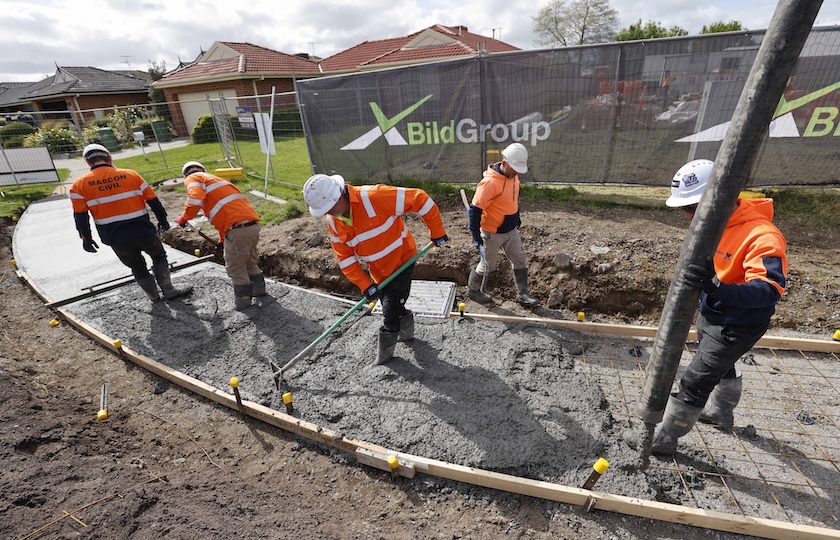
To find out, RMIT researchers partnered with local Australian councils to take the innovation from the lab directly into community infrastructure. In real-world field trials, both types of biochar were tested in concrete footpaths in Gisborne.
“We are currently working in the supply chain sector so that we can make this research into a mainstream product for commercial applications, and we’re not only looking into coffee – we’re expanding this into all forms of different organic waste,” said Dr Rajeev Roychand at RMIT University.
The expected outcome for pedestrians walking across the ‘coffee-ground’ pavement: No visual difference, and high performance and consistent durability in real-world weather and load-bearing.
A step closer to a circular economy
Beyond making pavements stronger, replacing 15 per cent of sand with coffee biochar offers a double environmental win:
- Diverting waste from landfills: It keeps organic material out of dump sites, reducing methane emissions generated by rotting waste.
- Preserving natural ecosystems: It directly reduces the volume of river and sea sand mined for civil infrastructure projects.
According to the initial assessments, substituting sand with coffee biochar reduces the overall carbon footprint of concrete production by up to 26 per cent.
As researchers continue monitoring these real-world footpaths and scaling supply chains with local councils, your daily espresso habit may soon be doing more than just waking you up. It could be paving the roads and sidewalks of future sustainable cities.


1 comment