
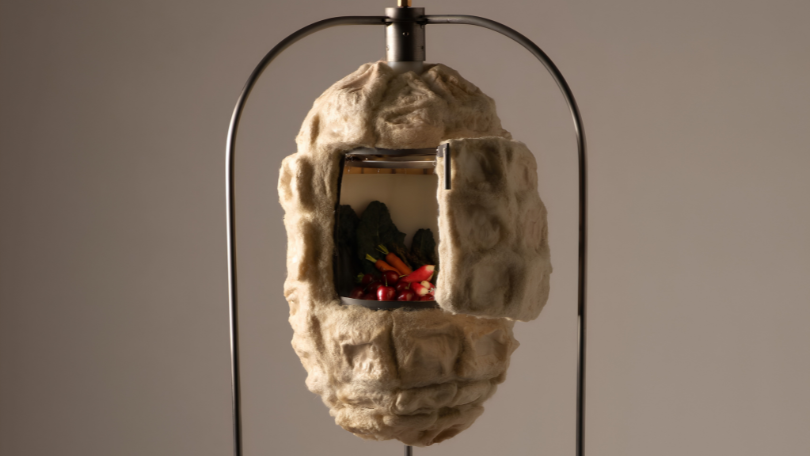
A refrigerator usually isn’t the kind of appliance you’d describe as fluffy, but designer Audrey Levy wants to change that.
The Central Saint Martins graduate created How to Grow a Refrigerator, also known as Xero Cool, using bacteria-grown materials and sunlight.
The compact fridge replaces the expanded plastic foam normally used for insulation with bacterial cellulose xerogel, a lightweight, highly insulating material that can naturally compost.
Levy developed the material herself at the CSM Grow Lab using non-toxic ingredients. Bacteria can produce cellulose, and when processed into a xerogel, it forms a low-density structure filled with tiny air pockets that help trap heat.
The fridge also uses felted wool for insulation and has internal panels that circulate cooled water to remove heat while keeping food away from the insulating materials.
Instead of running an electric compressor continuously, Xero Cool is designed to work with a solar-thermal absorption refrigeration system eventually.
Heat from the sun would trigger the cooling cycle, reducing the need for continuous electricity.
The system could also avoid the need for solar panels and batteries, which require mined materials. Because absorption refrigeration has no moving parts, it could be quieter and require less maintenance than conventional systems.
Levy’s idea comes from an uncomfortable contradiction: as the planet gets hotter, people increasingly depend on refrigeration and cooling.
“Researching refrigeration became a surprisingly radicalising experience,” Levy told Dezeen.
“Our overwhelming reliance on this technology presents a conceptually rich but terrifying paradox: as climate extremes intensify, so does our reliance on refrigeration.”
Levy estimates refrigeration is responsible for around 8 per cent of global emissions, including emissions associated with the electricity used to operate cooling systems and refrigerants.
Her alternative is deliberately softer and less appliance-like. The cocoon-shaped fridge makes its biological materials visible rather than hiding them behind the hard plastic shell of a conventional refrigerator.
“I would hope that the world in which this alternative refrigerator was adopted would be a reality in which we have re-evaluated relationships with the kitchen, food, and material cultures,” she added.
Unfortunately, Xero Cool remains a design concept rather than a ready-to-buy appliance.