

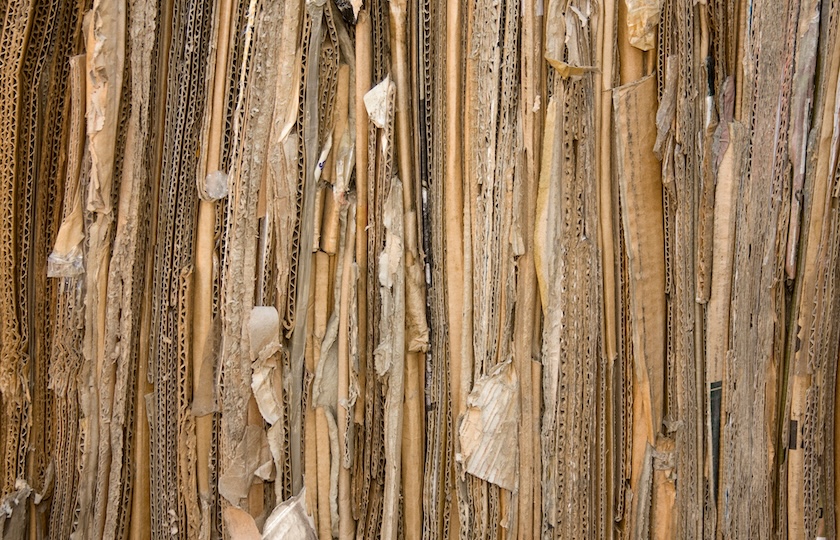
Researchers at RMIT University have developed a structural wall system that pairs discarded cardboard with soil and water, offering an alternative to conventional concrete construction.
Drawing inspiration from historical indigenous construction techniques that use local soil, clay, and fibers to build climate-adapted shelters, the technique, known as cardboard-confined rammed earth, involves compacting moist soil inside cardboard forms or tubes.
Once the earth dries and hardens, the surrounding cardboard stays in place as part of the structural wall.
The resulting assembly relies on the natural load-bearing capabilities of compacted earth, while the cardboard provides containment and structural support.
Cement production generates approximately 8 per cent of global carbon emissions. By eliminating cement from the rammed earth mix, the cardboard-confined method reduces carbon pollution by approximately 75 per cent compared to conventional concrete.
The process also creates a circular life cycle for paper waste; Australia alone discards over two million tons of paper and cardboard annually.
At the end of a building’s lifespan, the entire cardboard-and-earth structure can be dismantled and reused.
Financially, the method costs less than one-third the price of traditional concrete. Because builders can use clay-rich soil excavated directly from the construction site, material transport is largely reduced to lightweight cardboard forms.
This localised supply chain significantly lowers fuel consumption and shipping expenses, offering clear advantages for remote or regional building projects where logistics are costly.
Beyond carbon and cost reductions, rammed earth structures provide high thermal mass. The dense walls naturally absorb heat during warm daytime hours and release it as temperatures drop at night, regulating indoor humidity and temperature without reliance on mechanical air conditioning.
Led by Dr Jiaming Ma, the RMIT research team established mathematical formulas to calculate load capacities based on cardboard thickness, allowing engineers to design multi-story structures.
The research team, including Professor Yi Min Xie, is currently gathering performance data on compression, fire resistance, and moisture durability to meet regulatory standards and secure building code approvals for commercial applications.
- Further reading: Victoria solar project set to cut 227,000 tonnes of carbon annually.

1 comment