

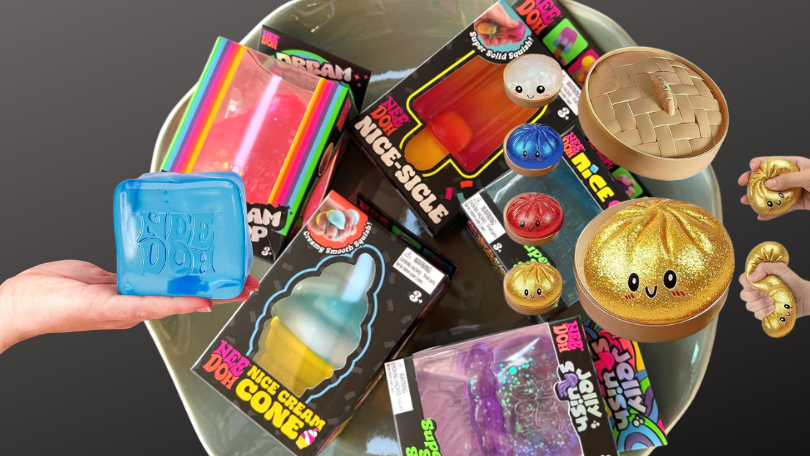
You’ve probably seen them. On a child’s desk, beside a colleague’s computer, or all over your social media feed.
They’re colourful, squishy, and oddly satisfying to squeeze. NeeDohs and other squishy toys have become the latest feel-good little objects promising a moment of stress relief, and, apparently, an excuse to collect several dozen of them.
But the squishy craze has another side that gets considerably less attention: What happens when we’re done squeezing?
Most squishy toys are made from materials such as polyurethane foam or thermoplastic rubber. They’re cheap, flexible, and durable, but generally aren’t recyclable or biodegradable. That means the cute little blob can ultimately become another piece of persistent waste.
So, before buying another one, it’s worth asking: Do you really need a NeeDoh?
Why are NeeDohs so popular?
NeeDoh is a brand of sensory toys made by the US toy company Schylling. The original toy was designed as an unusually soft stress ball, with different versions now available in a growing range of colours, shapes, and designs.
The appeal is pretty simple: Squeeze it, stretch it, squish it, and watch it slowly return to its original shape.
The toys have also found a place in stress management and self-regulation, with therapists and consumers using them as tactile tools.
Schylling CEO Paul Weingard has said he has been surprised by the wide range of ways people use NeeDohs, including students using them to help maintain focus.
Then social media got involved.
In 2023, Schylling reported that the NeeDoh range had attracted more than 150 million TikTok views and thousands of Instagram tags.
By early 2026, searches for “NeeDoh” had reportedly reached an all-time high, with demand so strong that some retailers sold out of shipments almost immediately.
At that point, it stopped being just a stress toy; it became a problem.
Oh no!
Collectible toys are designed to encourage repeat purchases. There is always another colour, character, shape, or limited edition to add to the collection.
That might be harmless enough when the toys are kept for years, but the problem comes when they are eventually damaged, forgotten, or thrown away.
The result? A product designed to give you a few minutes of sensory satisfaction can end up in the waste system for much longer.
And yes, there are safety questions too
Environmental concerns aren’t the only reason to think twice about what you’re buying. The rapid rise of squishy toys has also brought some product-safety issues into the spotlight.
This year alone, the US Consumer Product Safety Commission recalled more than 120,000 Funkee Monkee squishy toys over potential asbestos contamination. In the UK, regulators also recalled Squeezy Dumplings because of excessive benzene levels.
NeeDoh itself has faced a different problem: misuse.
Social media trends encouraged some users to microwave or freeze the toys to change their texture. Following reports of injuries, Schylling warned that heating, freezing, or microwaving NeeDoh products could be dangerous and added safety warnings to its packaging and online listings.
Is there a greener squishy?
At least one brand appears to be trying a different approach.
YumiSquishy markets its toys as an alternative made from food-grade, BPA-free silicone rather than conventional squishy foam. The company says its material is washable, reusable, and designed to last without crumbling or shedding.
It also uses reusable food-grade EVA zipper bags instead of conventional single-use packaging and says its products are hand-finished rather than mass-produced.
YumiSquishy also says its toys contain no added fragrance or painted-on designs.
That doesn’t automatically make a product environmentally perfect. Silicone still has an environmental footprint, and “reusable” is only meaningful if the product is actually kept and used for a long time.
What now?
There is nothing wrong with enjoying a squishy toy. For some people, the tactile sensation can genuinely help with focus, relaxation, or stress management.
The bigger issue is the collect-and-discard cycle.
If you already have a NeeDoh you love, the most sustainable thing you can probably do is keep using it. If it is still perfectly good, replacing it just because a new colour has appeared on TikTok offers little environmental benefit.
Because the most sustainable squishy may not be the one made from the fanciest material, it might just be the one you already own.
1 comment