

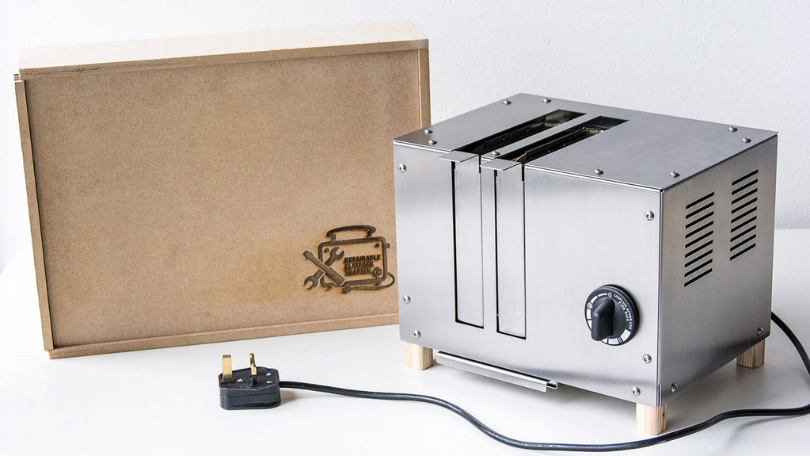
What if the best way to stop people from throwing away broken appliances was to have them build them in the first place?
That question inspired designer Kasey Hou to create the Repairable Flatpack Toaster, a self-assembly appliance designed to tackle one of the world’s fastest-growing waste streams: electronic waste.
Developed as Hou’s graduate project at the University of Edinburgh, the toaster arrives flat-packed with all of its components and an instruction manual. Users assemble it themselves, making it easier to understand how the appliance works – and, hopefully, how to fix it when something goes wrong.
“The context of the project is e-waste,” Hou told Dezeen.
“The amount of e-waste increases every year, and only a small percentage of it is recycled and reused. The issue will likely get worse since more and more electrical and electronic products will be purchased and disposed of.”
Rather than treating appliances as disposable, Hou wanted to rethink how they are designed in the first place.
“One of the solutions is to increase the lifespan of products either through emotional design or repair,” she said.
“I want to challenge the fact that most products are not designed to be repairable; they can only be thrown away when they stop working.”
The stainless-steel toaster is designed so that individual parts can be removed and replaced if they fail, rather than discarding the entire appliance. Its modular design also makes it easier to clean and, eventually, dismantle for recycling.
Hou believes assembling the toaster yourself makes repairs feel far less intimidating.
“If the user can assemble the toaster from scratch, then they will feel more comfortable and confident to repair it because they are familiar with the structure of the toaster and how it works,” she said.
While the toaster is still a concept, Hou said she hopes to bring it to market after refining the design to make it even safer and easier to repair.
At a time when millions of electronic products are discarded every year, the project offers a simple idea: products that are designed to come apart may also be the ones that stay in use the longest.

1 comment