
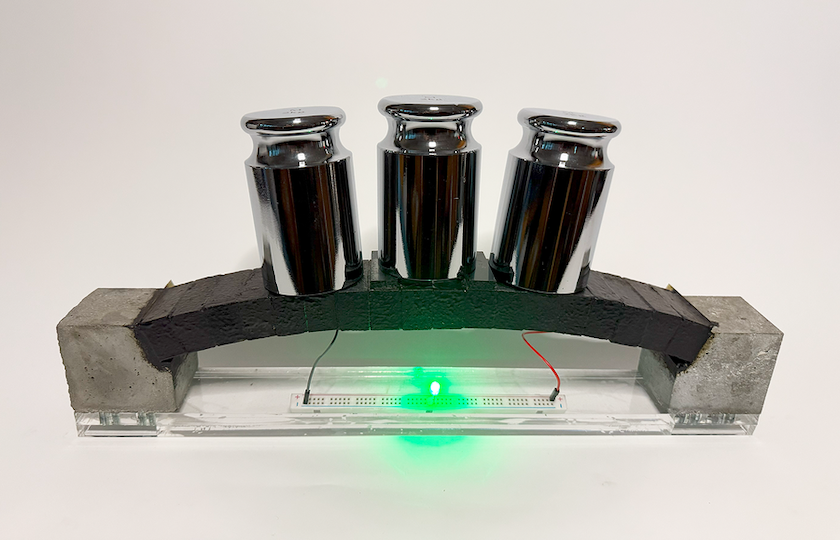
Imagine powering a home through the very foundation beneath it.
Researchers at the Massachusetts Institute of Technology have created a version of concrete that stores electricity directly inside structural building materials, opening up new ways to keep renewable energy close at hand.
The material mixes cement, water, fine carbon black, and simple electrolytes. As the mixture cures, the tiny carbon particles settle into microscopic patterns around tiny pores within the concrete. This network allows electricity to flow through and safely reside within ordinary walls and floors.
The newest version, called “ec^3”, stores slightly more than two kilowatt-hours of power per cubic metre. That means that around five cubic metres of the material contain enough energy to meet the daily needs of a standard household. Earlier iterations required nearly nine times as much material to hold the same amount of power.
Because the system uses widely available elements like cement and carbon, it avoids reliance on mined metals such as lithium and cobalt. This makes local energy storage simpler to build and easier on natural ecosystems.
While the technology offers a quiet way to keep solar power running after sunset, engineers note that the material works best for steady, lower-power needs rather than sudden high spikes.
Adding too much carbon can also lower the structural strength of the concrete, so researchers are carefully testing balance points between power capacity and building safety.
Looking ahead, the team plans to track the long-term durability of the material under repeated charging cycles, ensuring it remains strong over decades of use.