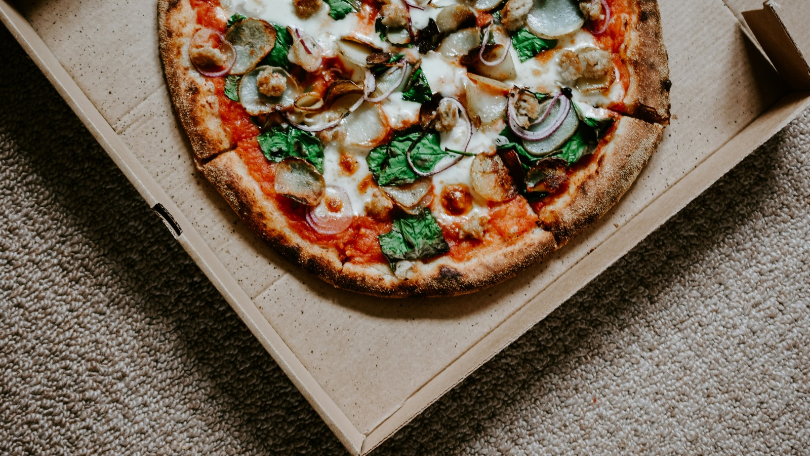
A pizza box has a pretty straightforward job: Keep the grease off your hands and the cheese off your car seat. But some of the chemicals used to make food packaging grease-resistant can stick around long after the pizza is gone.
The European Union is introducing new packaging rules that target both packaging waste and the substances used to make packaging. Among the changes is a restriction on per- and polyfluoroalkyl substances (PFAS), commonly known as “forever chemicals”, in food-contact packaging.
Forever chemicals resist breaking down and can accumulate in the environment and the human body over time. They’ve been used to make everyday items such as takeaway containers, pizza boxes, microwave popcorn bags and bakery paper resistant to grease and water.
Under the new rules, food-contact packaging containing PFAS above specified limits can no longer be placed on the European market. Manufacturers will need to check their materials and, where necessary, find alternatives that meet the requirements.
A suitcase full of plastic per person
Chemical restrictions are only part of the picture. The regulation also addresses how much packaging waste Europe produces and how much of it can be reused or recycled.
Without further action, packaging waste across the EU was projected to grow by 19 per cent by 2030, while plastic packaging waste alone could increase by nearly 46 per cent.
Eurostat, the EU’s statistical agency, puts annual plastic packaging waste at more than 35 kg per person. That’s roughly the weight of a large suitcase, generated for every person across the bloc each year.
The figures help explain why the new rules go beyond the materials used in a pizza box or takeaway container. The regulation aims to change how packaging is designed, produced and managed after use, with less waste and greater resource efficiency as key goals.
More changes are on the way
The Packaging and Packaging Waste Regulation (PPWR) is being rolled out in stages, with further requirements planned over the coming years.
From 2028, a harmonised labelling system is expected to help consumers identify how packaging should be sorted for recycling. The EU also expects the common system to streamline recycling and composting operations, potentially saving the packaging industry several billion euros over time.
By 2030, additional measures will address excessive empty space in packaging, certain single-use plastics and business reuse targets. Packaging makers will also face requirements for recycled plastic content and recyclability.
For manufacturers, meeting these rules could mean redesigning packaging, changing materials or adjusting production processes. Those changes may bring upfront costs, but the regulation aims to establish more consistent requirements across the EU while supporting the use of materials for longer.
The broader ambition is to help Europe reach climate neutrality by 2050 through a more circular economy, where resources are reused and recycled rather than discarded after a single use.
For shoppers, many of these changes may not be immediately obvious.
The takeaway box could look much the same, even as its materials change. The bigger difference will be in what’s used to make it, how easily it can be recycled and what happens to it after the food is gone.