

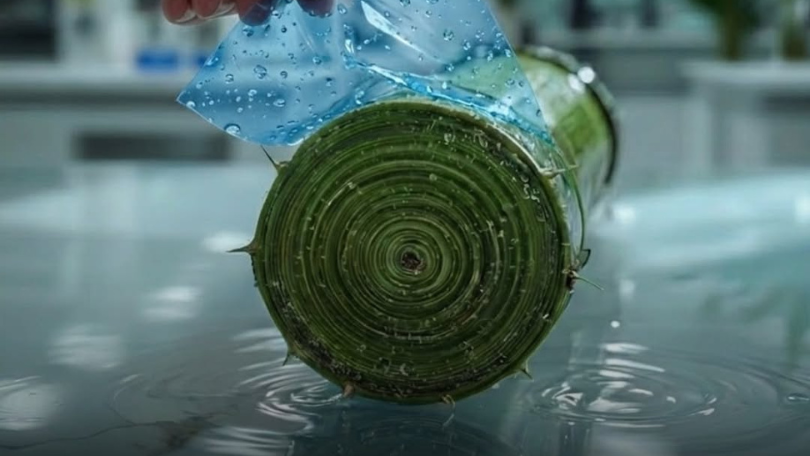
What if one of the world’s fastest-growing plants could help replace conventional plastic?
Researchers in China have developed a biodegradable bamboo plastic that is strong enough for industrial use but breaks down naturally in soil in 50 days.
Published in Nature Communications, the new material was found to outperform several commonly used plastics in strength while remaining fully biodegradable.
Conventional bamboo composites often combine natural fibres with epoxy or plastic polymers, reducing the amount of plastic used but not eliminating it. As a result, they still behave much like traditional plastics at the end of their life.
The new material takes a different approach.
Developed by researchers led by Dawei Zhao and colleagues at Shenyang University of Chemical Technology and Northeast Forestry University, the plastic uses molecular engineering to create a material that is both fully biodegradable and recyclable.
Laboratory tests showed the bamboo plastic has a tensile strength of 110 megapascals: around twice that of materials such as polylactic acid (PLA) and high-impact polystyrene.
It also retained up to 90 per cent of its original strength after recycling, allowing it to be reused multiple times before eventually biodegrading.
The researches said their choice of bamboo was no accident
Bamboo grows rapidly – sometimes by as much as a metre a day – and produces around five times more biomass than timber.
Because it is not a food crop, it also avoids competing with agricultural land used for food production. The bamboo plastic also resists moisture and corrosion, making it suitable for applications where many biodegradable plastics struggle.
Potential uses include automotive interiors, electronics housings, household appliances and infrastructure components.
While more work is needed before the material reaches commercial scale, including expanding production and improving bamboo processing, the researchers believe it could open the door to wider use of renewable, high-performance plant-based plastics.

1 comment