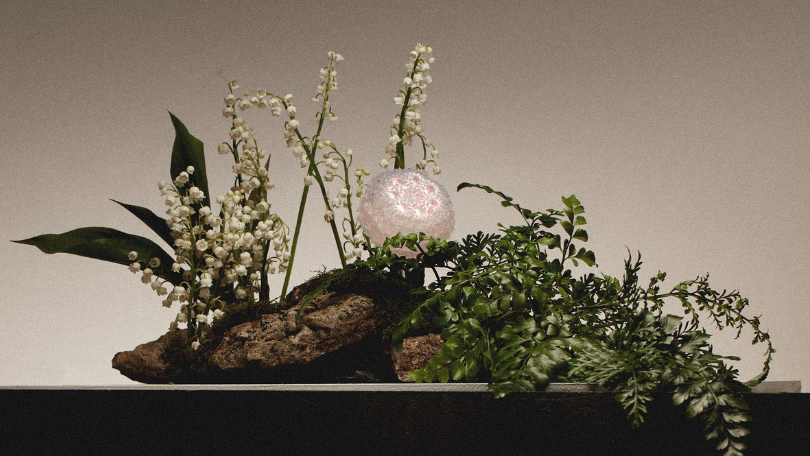
A British designer has developed artificial flowers designed to help bees and other pollinators locate real plants in urban areas where air pollution can interfere with their ability to find food.
Created by Justina Alexandroff, the project, called Faux Flora, aims to address a growing challenge for pollinating insects.
Research has shown that air pollution can degrade the scent of flowers, making them harder for bees and other insects to detect. Rather than replacing natural flowers, the artificial blooms are intended to work alongside them.
Placed among real plants, Faux Flora acts as a visual and scent-based beacon, helping guide pollinators toward nearby flowers.
The project combines digital design, material science, and scent chemistry to create objects specifically tailored to how insects recognise plants.
“Insect biodiversity is unimaginably important, and we are seeing a decline in populations globally,” Alexandroff said.
“It’s being referred to as the ‘insect apocalypse’.”
Pollinators play a critical role in ecosystems, helping reproduce flowering plants and supporting food production.
According to Alexandroff, insects pollinate around 85 per cent of flowering plants while also contributing to nutrient recycling and food webs.
The project began as part of Alexandroff’s master’s studies in Material Futures at Central Saint Martins.
Her design builds on research by biologist Aditi Mishra, published in the journal ‘The Science of Nature’, which identified three key traits insects use to recognise flowers: radial symmetry, scent, and reflective surfaces.
Alexandroff recreated and amplified these features in her artificial flowers.
The 3D-printed structures use fractal-inspired shapes similar to patterns found throughout nature, including pollen grains. To attract insects through scent, Alexandroff collaborated with NICE Labs in India to develop a fragrance formula, incorporating jasmine because its scent remains detectable even in polluted air.
The flowers also feature structural colour, a technique that creates colour through microscopic surface structures rather than pigments, producing a reflective effect that can attract pollinators.
Alexandroff describes the project as a response to ‘sensory pollution’, where human activities interfere with how other species perceive their environment.
“They do so many different types of ecosystem functions – forming the foundation of food webs, pollinating 85 per cent of flowering plants and recycling nutrients – yet there’s no coherent strategy to slow and reverse the damage humans are causing,” she explains.
While the current prototypes are from resin, Alexandroff hopes future versions could be produced in ceramic. She envisions the devices functioning like reusable scent diffusers that can be periodically replenished with pollinator-friendly fragrances.
“Clay is already used in scent diffusion due to its porosity, and these devices could therefore be watered with the scent formula, much like you water a plant,” she added.
“I see these devices as becoming more like pollinator scent diffusers – using a ‘pollinator perfume’.”